Dubai Real Estate Is Splitting in Two

Migration keeps the market standing while the region shakes. What the data says about where prices go from here.
Intro
Dubai's real estate market once again finds itself in a peculiar position. On one side, the city has become so established and so dominant in the region that continued migration props up demand even through harder times. On the other, instability across the region is a drastic consideration for the marginal entrant, the buyer deciding this quarter whether to commit capital or wait. The market is pulled in both directions at once, and headline figures hide which force is winning. In this piece I go through what the data indicates, what the market is actually doing right now, and where it is heading.
For those new here, I am Emil. I have worked in real estate construction, development and M&A. My analysis is data driven, with historical parallels drawn where they help explain the present. I have studied finance, data science and strategy in both Finland and Japan.
Six Weeks of "Tomorrow"
When the war broke out, my first thought was simple: this is really bad. Cap rates should have a risk premium added to them, and the marginal entrant, the person who was about to relocate or buy, would not come. My first reaction was that prices would come down by more than 30%. I debated the topic with Grok and Claude, and both were convinced this was a 5 to 10% dip. Early data did not look negative, and for six straight weeks the rhetoric was that the war would end the next day. Now we have several months of data. We can look at what the market actually did, and more importantly at what is likely to happen next.
The first chart shows what buyers paid per square metre.
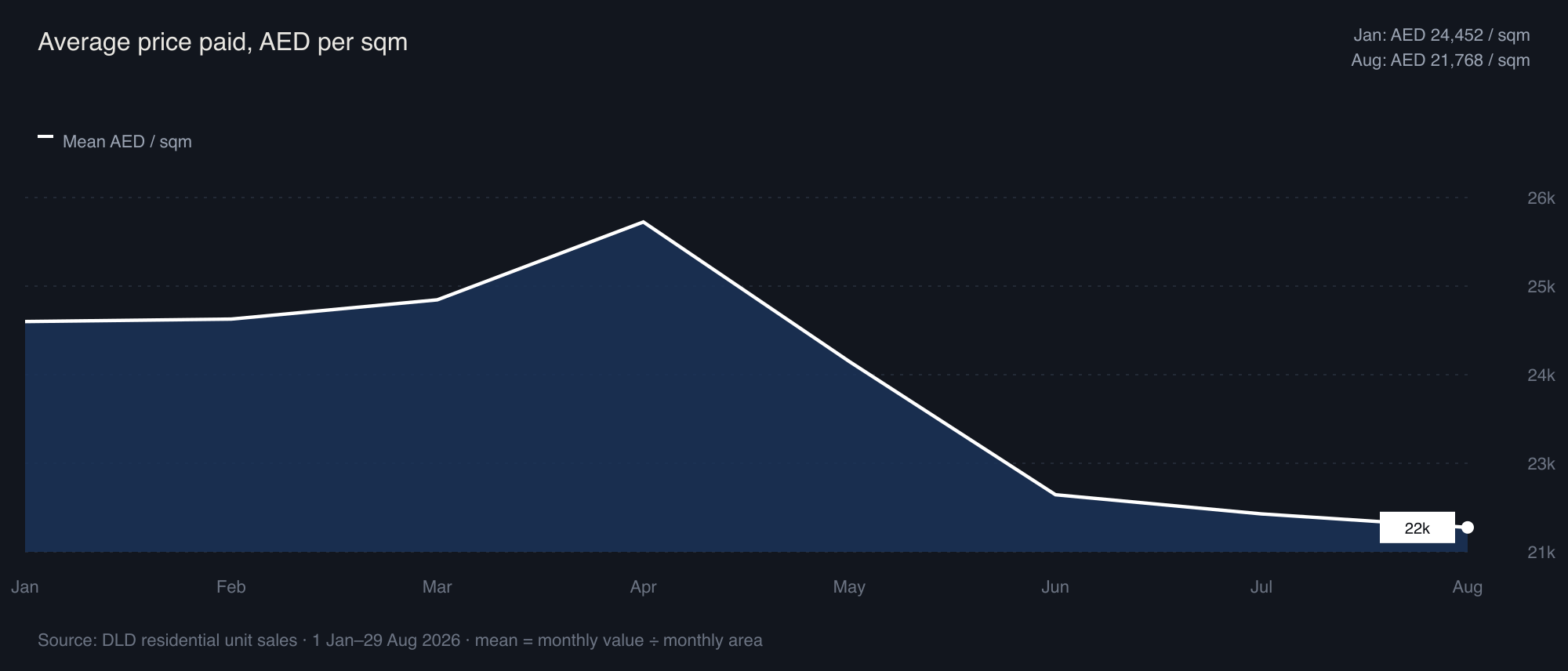
It shows a surprising rise all the way into April, before turning lower towards the summer. This chart is, in many ways, what the early predictions of the market were built on. Resilience, and talk of the market being flat to slightly downward sloping over the coming year.
But this is a horrible chart, and it does not really tell us anything.
A slightly better chart, though still not very useful, is unit volume.
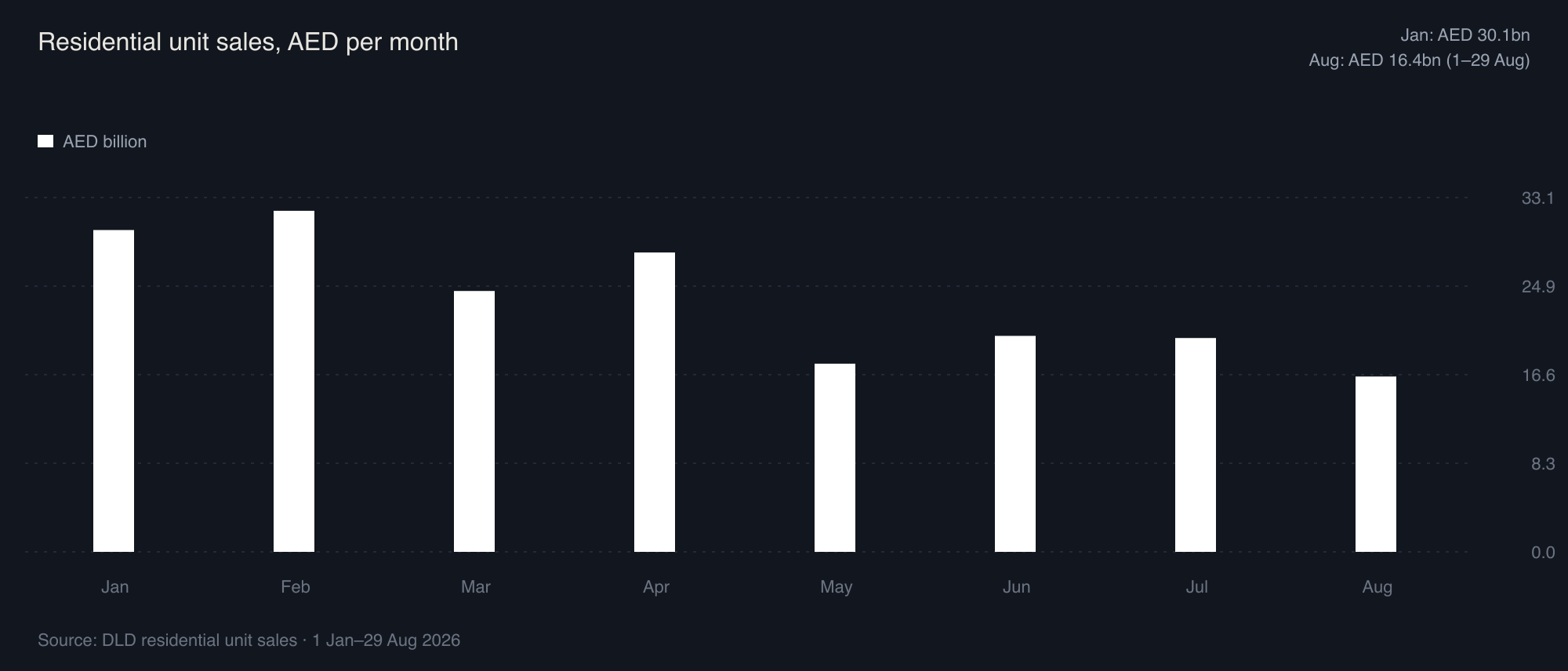
Here we already start to see a pretty big decline in volume post war versus pre war. But it too fails to capture what is really going on, and it is distorted by seasonality.
The Bipolarisation
To really understand what is going on in the market, you have to look at what the different price ranges are doing. The chart below splits apartments into two groups: those sold under AED 800k, and those sold above.
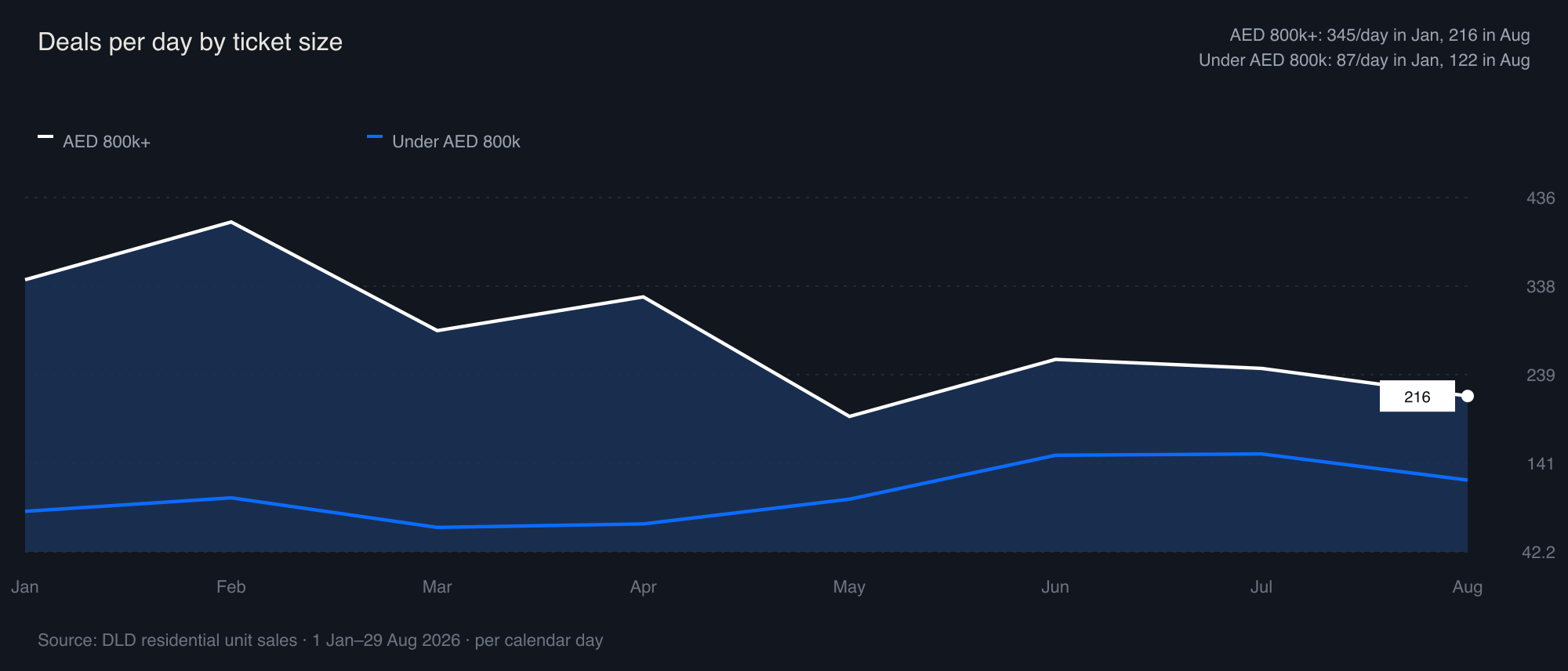
Something fascinating is happening here. Apartments under AED 800k are drastically up. We are talking almost a doubling.
Meanwhile, apartments above AED 800k have almost halved in AED volume.
So what is going on?
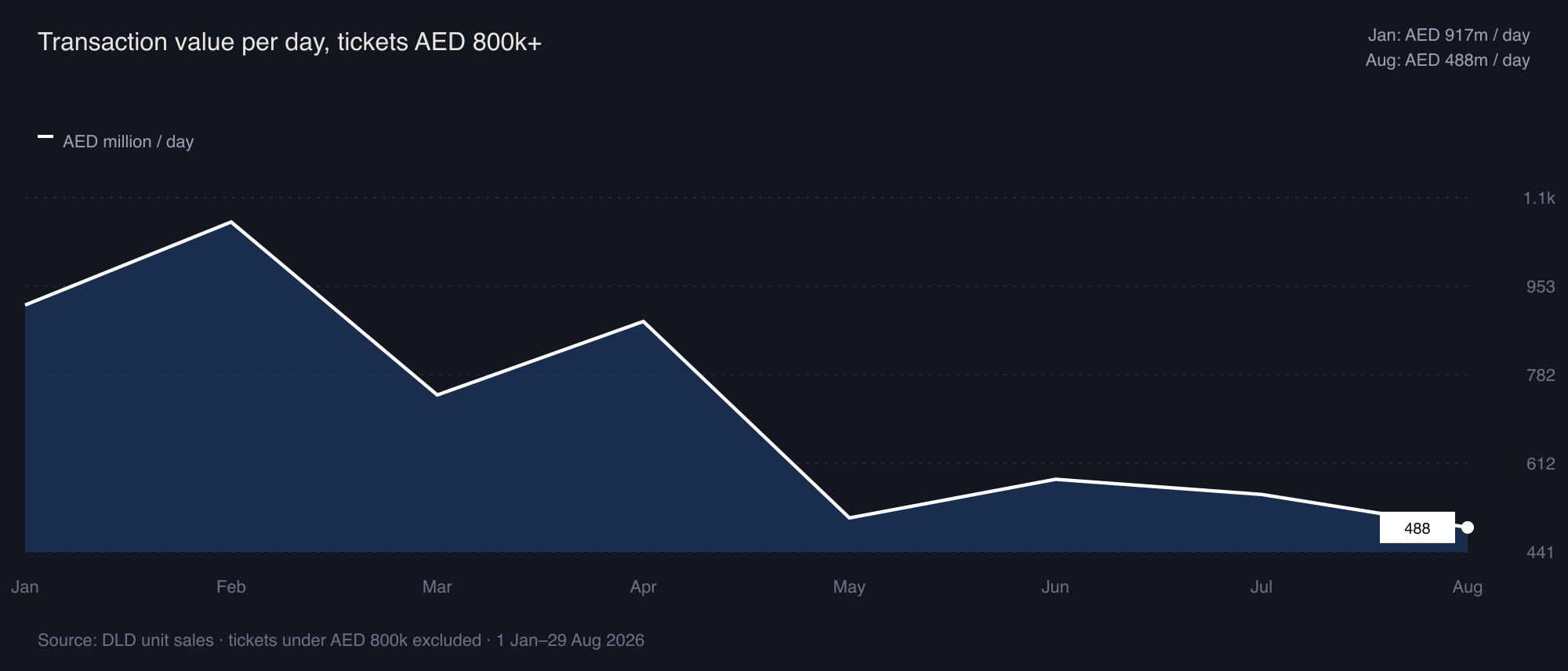
There is a quite simple explanation for why the sub AED 800k category is booming. The most powerful force is the residency investment threshold. Until April 2026, the two year property investor visa required a completed property worth at least AED 750k. Dubai Land Department scrapped that floor entirely for sole owners, with joint owners needing only AED 400k each. My chart cuts at 800k rather than 750k, but the segment is the same one. On top of that, banks have been offering the most attractive financing in years, with fixed rates from around 3.75%, and mortgaged units still qualify for the visa. The result is a huge wave of buyers who previously could not reach the investment visa and now can, with a studio and a bank loan.
And when you look at the timing of when this change took effect, you start to see why the market looked so strong even while the war was raging on.
The Brutal Right Tail
So we know the market is strong under AED 800k. I would classify this as a semi durable tailwind. The subsegment will likely keep supporting the market for a while yet. We are talking about an entirely new class of people who now see Dubai as a place where they can actually live, not just visit. That should lift demand in the segment structurally rather than behave like a synthetic one off. It is unlikely that the buying pressure strengthens from here though, since some of the initial surge is pent up demand being released at once.
Now look at the chart below. It shows how different price bands are behaving in unit volume terms, pre war versus post war.
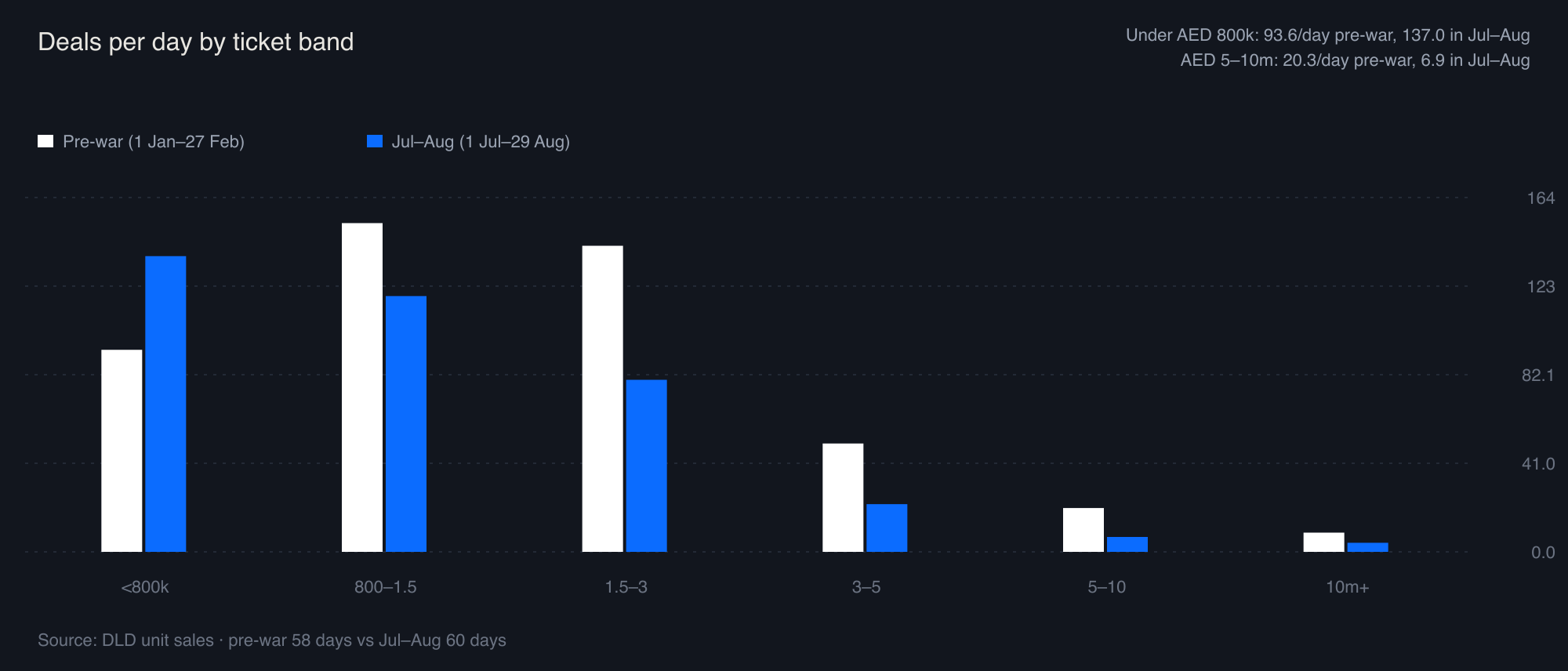
On the left you see the sub 800k category, where volume is up a lot. Moving to the right you start seeing the opposite, and with more force. The further you move into higher value bands, the bigger the decline in unit volume. The AED 3 to 10 million range is especially hard hit, with volumes down by more than half.
What does this mean? It means a lot of wealthy buyers and family buyers are not buying. A working hypothesis goes like this. If you have a family and you were entertaining the idea of moving to Dubai, you are likely much further away from being that marginal buyer after the war than before it. Some of that is postponement. Some of it is a permanent loss of inflow.
To really understand the scale of the shift, the chart below shows the share of the market made up of sub AED 800k apartments and studios.
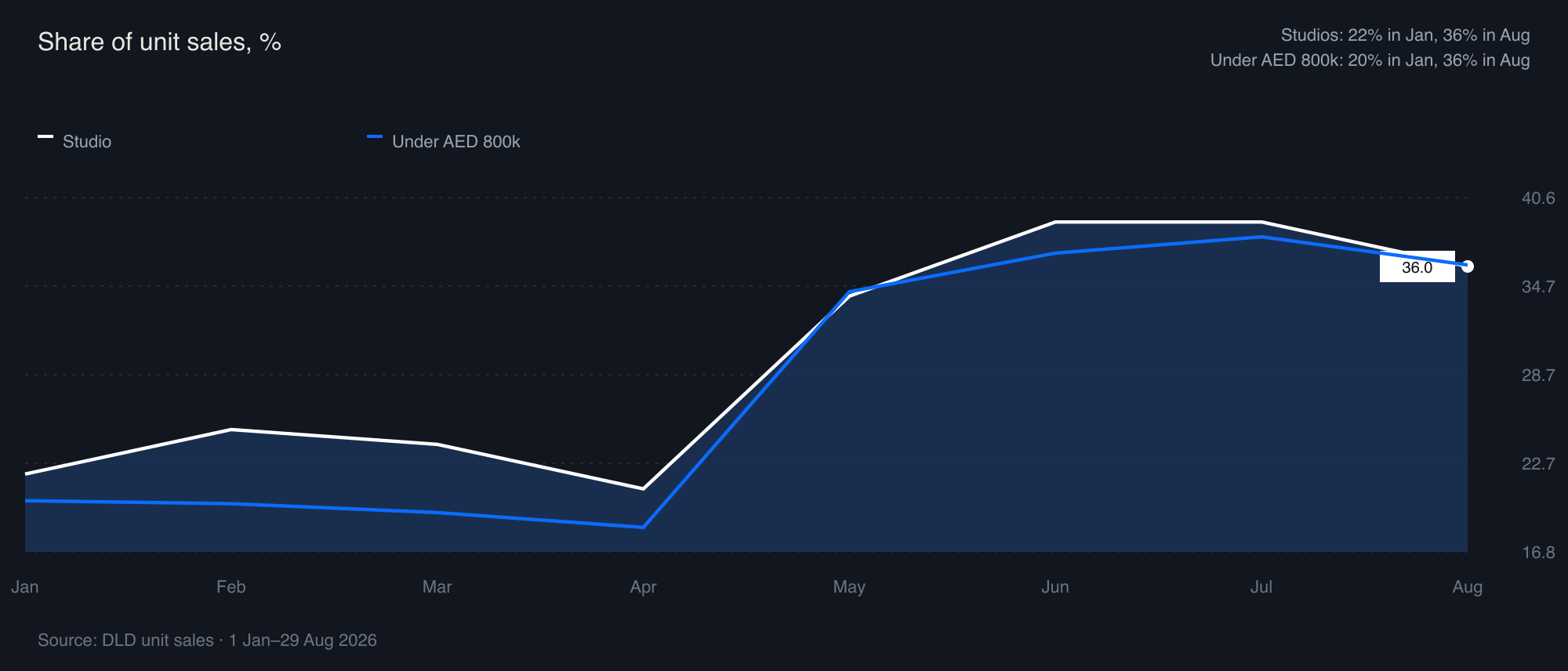
The subsegment that previously represented around 20% of the market now represents almost 40%.
This is an enormous shift, and its effects will show up in many places. More and more off plan development will be steered into this segment. Many high end, non prime plans are probably being scrapped as we speak and redrawn as low cost studio complexes. It is the prudent move when you have no visibility into how the high end market will perform.
From a game theory standpoint, the likely outcome is that more and more developers migrate towards the lower cost market. Meanwhile some of the more promising off plan sites will be frozen or replanned. Developers will go into this segment because they have to deploy capital somewhere and keep their organisations intact. The question is at what cost. The low end looks attractive, and in many ways it is the prudent market to enter, but it comes with its own perils. The sub 800k segment is far more homogeneous, which leaves much less room for developers to add value. That will likely drive margins in the segment way down within a few years. I will touch on this more later in the piece and in future ones.
Where the Damage Sits
The price bands tell you who stopped buying. The areas tell you where.
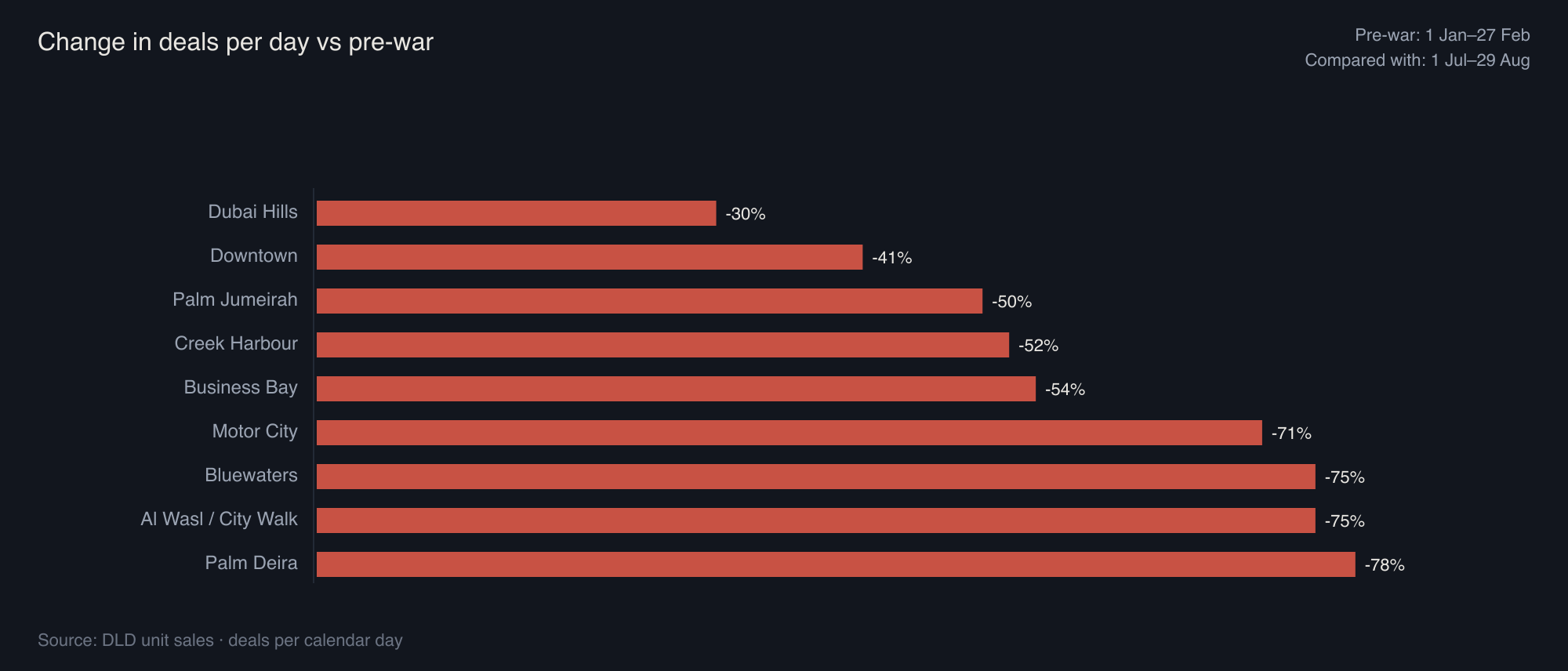
First thing to notice: every area on this chart is down. None of the established or prime districts are part of the sub 800k boom. That boom lives in JVC, International City, Dubai South and the like. So the split is geographic as much as it is about price.
Second, the comparison is peak season against summer, so the level of decline is exaggerated. The dispersion is not. Seasonality does not explain why Dubai Hills is down 30% while Palm Deira is down 78%.
The ordering is telling. Dubai Hills and Downtown hold up best. Both are built, both have deep secondary markets, and the people buying there are mostly already in Dubai, moving within the city. That buyer is not the marginal entrant. He was in before the war and he is still here.
The further right you go, the more the buyer is someone from abroad. Palm Jumeirah is the international trophy buyer. Creek Harbour and Business Bay are heavily off plan, so part of the decline is developers holding back launches. And the right tail, Bluewaters, City Walk and above all Palm Deira, is launch driven and speculative. Palm Deira is the cleanest example. Almost entirely off plan, sold to people underwriting appreciation between launch and handover. That is the marginal entrant in his purest form, and he was the first to go.
This fits the earlier analysis. The marginal entrant from abroad, whether he was buying paper or buying a home, has stepped back. The buyer who was already resident kept going. The areas that depend on the former have been hit hardest, and the areas that depend on the latter have barely noticed.
The Future Path
Now that we have a good picture of how the residential market looks, I will spend some time going through scenarios from different stakeholder perspectives.
The outsider
For people looking at Dubai from the outside, the market looks surprisingly healthy. Prices have barely budged and the year on year numbers are flat. The story goes roughly like this: the market was so hot that the war only cooled it down slightly. In some ways this might be right. It is entirely possible that we get a peaceful resolution in the region and the marginal buyer rushes back in, reassured by how stable the headline figures looked the whole way through.
The marginal entrant
Here we will see continued bipolarisation. The rich marginal entrant will second guess and choose Italy or Switzerland instead of Dubai. Not all of them, but some. They do this for two reasons. Some see war and feel fear. Others wonder whether the economic uncertainty will, reflexively, raise taxes and slow the region over the long term. Knowing exactly what they will do is of course hard. But one thing is clear. Ask whether there is more or less reason to move to Dubai after the war than before it, and you have an answer that gives you direction.
That said, when we talk about marginal entrants we have to remember the influx of new buyers in the sub 800k segment. The new legislation means that some portion of the Asian middle and upper middle class will become marginal entrants. The immediate effect is positive. Volumes stay higher and contractors and developers have something to do. But it is not as valuable an inflow as UHNWIs.
Developers and contractors
I already talked about how more and more volume will shift into the lower priced segments. Pretty much every building that can still be modified internally will likely end up with smaller apartments.
And as I said, it is the prudent move. To survive you have to shift, at least temporarily, into the new segment. You probably also have to shrink. There simply is not as much business for a while. Couple that with the huge amount of stock coming in 2027 and it is hard to be very optimistic on developers.
Weaker private players are likely to go bust in the coming years. Some plots will trade at drastically lower prices than they sold for in 2025. More importantly, some of the insane margin that players like Emaar have been racking in from owning a huge stock of cheap land will disappear for a while.
There are no right or wrong moves in this market other than to survive. And this is where we get into timing. I do not think the market is anywhere close to really feeling the sting. There still appears to be a lot of optimism around. The so called dip buyers are in full swing and a V shaped recovery seems to be consensus. I do not quite buy it. To me it looks far more likely that the market enters a correction lasting a year or two, and that we have not seen the bottom in prices. Not even close. We know volume leads price, and we know there is a huge amount of stock coming in 2027. That is pretty much a perfect recipe for lower lows. For me to believe we have truly bottomed I would need to see more fear and more despair.
This might sound pessimistic. On the contrary. Situations like this are some of the most interesting times to look at a market. This is where the next decade's winners and losers get decided. A developer doing the right thing in this market will be the player that dominates the next twenty years. Look at the Japanese developers that thrived by buying tiny plots in prime areas like Ginza and building on sites everyone else considered too hard. Similar players are likely to gain an edge here as well. Developers ready to buy the hardest hit segments, hospitality for instance, at the right time may end up getting the deal of the decade.
For more on this topic, subscribe and send me a message if there are particular niches you want to hear more about. I will be covering all the listed players in the near future.
Author's note
That is all for this first edition of my Dubai market overview. I am planning to make this a monthly series, each edition looking at a different aspect of the market. The purpose is to give unbiased commentary that does not speak for just one stakeholder. The current problem is that most of what gets published on this market is terminally bullish in one way or another. Truly independent research is scarce.
Subscribe
Independent research on global real estate developers