Why Paimio Research exists
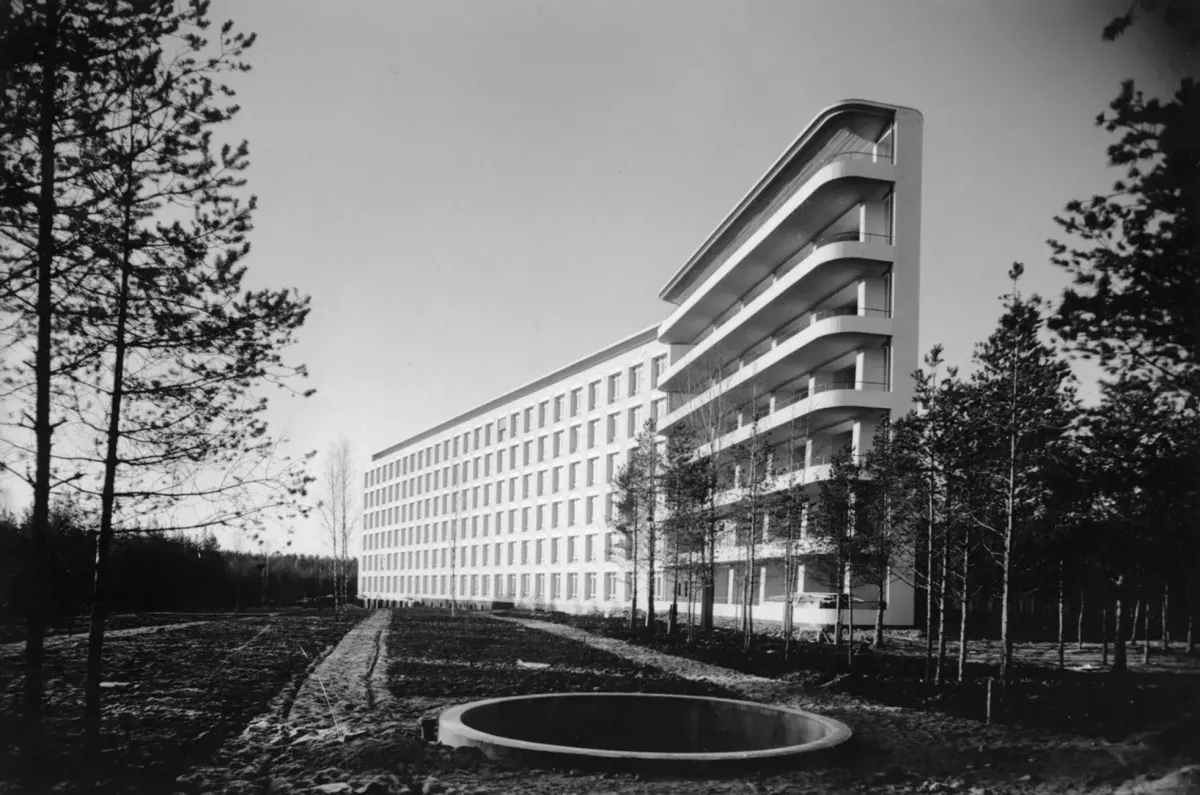
1930
In the spring of 1930, a young Finnish concrete engineer sat down to check whether a building could hold its patients in the air. The architect, a then unknown named Alvar Aalto, had drawn a seven storey wing of open terraces cantilevered into the forest sky, so that patients could be wheeled out in their beds to take the sun. The engineer was Emil Henriksson. In 1933, the year the Paimio Sanatorium was completed, he changed his name to Hartela and founded a construction company that his family still runs. The building is now protected as a World Heritage site. I am the fifth generation of the family he started, and I carry both of their names: Emil for the engineer, Alvar for the architect.
I begin there because that spring shows something the industry rarely says out loud. What limits building is not fixed. It migrates.
In 1930 the binding constraint was know how. A generation later it had moved: the postwar decades were limited by whether anyone could organise building at scale, and the winners industrialised the site, the schedule and the workforce. Today, in most developed markets, almost anything can be engineered and organised. What limits building now is financing and conception: who can assemble the land, structure the capital, and tell a story persuasive enough that the money arrives before the concrete. My own family's trade has lived through every one of these turns, which is perhaps why I find it impossible to look at a skyline and see anything other than the constraint that produced it.
And underneath the slow migration runs the fast machine: the cycle. Roughly every two decades, in market after market, real estate swings from euphoria to ruin and back. Optimism becomes credit, credit becomes land prices, and land absorbs the mania first and most violently. Land is the residual claim: what buyers will pay for the finished homes, minus the cost of building them and the developer's margin, is what the plot is worth. Build costs move slowly, so when prices rise the gain lands on the land, and when they fall the land takes the loss. A permit changes the arithmetic again, turning a plot that might one day be built on into one that can be built on now; much of the value is created there. Land bought right is often most of a developer's return; land bought at the top can eat a decade of good execution. Careers are shorter than cycles, which is why the industry's memory fails on schedule.
Put the two together and you have the developer's problem. A developer commits capital years before it sees revenue: land first, then permits, design and the first contractor payments, and only later a sale that can be booked. Every plot is a bet on the market that will exist at handover, not the one that exists at signing. Land and permitting delays stretch the gap; the cycle decides what waits at the end of it.
Execution does not make it easier. Bent Flyvbjerg, who studies large projects at Oxford and the IT University of Copenhagen, calls the pattern the iron law: over budget, over time, under benefits, over and over again. In the database behind How Big Things Get Done, his 2023 book with Dan Gardner, fewer than half of more than 16,000 projects came in on budget, and half a percent came in on budget, on time and with the benefits promised.
His remedy has two parts. The first is think slow, act fast: planning is cheap and safe, delivery is expensive and dangerous. The second is modularity, which he explains with Lego: big things built from small, repeatable units, so every repetition moves you down the learning curve. In his data, solar and wind farms are among the lowest risk project types; nuclear plants and the Olympic Games, one-offs by nature, among the highest.
Developers live on both sides of that line. The signature tower or the master plan launched all at once is a megaproject with a sales brochure. The developers who compound look more like the wind farm: a repeatable product, refined building by building, released in phases so that each launch is priced on what the last one actually sold, on land bought with discipline and funding matched to the life of the project. One of my favourite sayings in development is festina lente, make haste slowly. Suetonius records that Augustus quoted it often, in the original Greek. Flyvbjerg's think slow, act fast is the same idea two thousand years later. Be slow with the land, the concept and the plan. Be fast once the concrete starts, because time on site is where the risk lives.
The rest of the inefficiency is structural. The contractor base is fragmented, each firm optimising its own slice. Pre-sales and escrow bring the buyer's money in early, which funds the build but locks in prices set before the costs are known. And the information used to decide what to build is thin: a developer usually knows its own weekly sales in detail, and little about what the rest of the market is selling, at what ticket, in what unit type. What information does exist is supplied by participants in the transaction: brokers paid by the deal, consultancies paid by the developers, banks paid by the mandates. Their work is often skilled, but each of them is compensated by the market going one way. No one in this field is paid to be right. Paimio Research exists to be that party.
What buyers pay for is changing too. Homes are sold less by the square metre and more as a concept, a way of living with a name attached. Branded residences are the clearest case: a hotel, fashion or car brand on the building, and buyers paying for the concept as much as the space. Savills puts the average premium over comparable unbranded schemes at about a third, while noting that established hotel brands still carry the most trust. The concept has become part of the product, and it has to be designed and tested like the rest of it.
Before Paimio I spent years building revenue nowcasts from public data for Nordic listed companies, archived at emilhartela.com with a record that can be checked against what was reported. The method carries over: a developer's revenue is written down in contracts and registries long before it reaches the income statement.
What will appear here is simple. Company research on developers as businesses: sales, backlog, land, balance sheets and funding, written for professional investors and for the people who run these companies. Sales updates built directly from registry data wherever a market keeps one, saying what actually happened. The first work is on Dubai names, because Dubai's registry records every transaction since 2004: a case, not the scope. And forecasts of developer sales and revenue, made before the results and checkable afterwards, because an analyst who will not put a number on the record is a commentator.
The name comes from the building. The architect became famous for it; the engineer's calculations are why it stands. That division of labour is the standard this publication sets for itself: someone else's skyline, our mathematics underneath it.
If you invest in developers, lend to them, build for them, or run one, this letter is written for you. It is free to read, and it is paid for only by its readers; no developer, broker or platform has a commercial relationship with it. The numbers behind it are how the work is funded.
Emil Hartela
Subscribe
Independent research on global real estate developers